Why plantar fasciitis treatments keep failing nurses, teachers, and anyone on their feet all day
If insoles, cortisone shots, and physio haven't fixed your morning pain, here's what most people don't know about the tissue that's actually causing it — and the 3-part protocol podiatrists quietly recommend at home.
If you're reading this, you probably already know the feeling.
That sharp, stabbing pain in the bottom of your heel the second your foot touches the floor in the morning. The 15-minute hobble to the bathroom. The way your foot grudgingly "loosens up" as the day goes on — only to wake you up again the next morning, sharper than yesterday.
If you're a nurse, a teacher, a retail worker, a stylist, a server — anyone who spends 8 to 12 hours a day on hard floors — you've probably accepted this as part of the job. It isn't. It's a treatable inflammation problem. And the reason almost nothing you've tried has worked has very little to do with you, and almost everything to do with what's actually happening in the tissue underneath your heel.
You've probably already tried most of the standard playbook:
- Custom orthotics (often $300–$800)
- "Podiatrist-recommended" sneakers — Hokas, Brooks, the works
- Stretching routines from YouTube you do for a week and forget
- Rolling a frozen water bottle under your foot every night
- Ibuprofen before every long shift
- Maybe even a cortisone injection that worked for 6 weeks before the pain came back — worse than before
And yet here you are. Still waking up bracing for that first step. Still sitting down the moment you get home and refusing to get up again until bed.
You're not alone. Plantar fasciitis is one of the most common chronic foot conditions in adults — and one of the most stubbornly hard to fix. Most sufferers cycle through the same standard treatments for years without lasting relief.
There's a reason most of those treatments fall short. And it has nothing to do with you not trying hard enough.
What's actually happening in your foot
The plantar fascia is a thick band of fibrous tissue that runs from your heel to your toes along the bottom of each foot. It absorbs the impact of every single step you take. When it becomes inflamed and stays that way, you get the classic stabbing heel pain that defines plantar fasciitis.
Here's the part most people don't know — and most insole companies will never tell you:
The plantar fascia has very poor natural blood supply.
That sounds like a small detail. It isn't. Blood is what carries oxygen, nutrients, and inflammation-clearing cells into damaged tissue. Without strong circulation, inflammation lingers. Damage doesn't repair properly. The tissue stays stuck in a slow-healing loop — sometimes for years.
Every 12-hour shift on a hard hospital or store floor creates tiny micro-tears in that tissue. Your body wants to heal them. But it can't flush them out or repair them efficiently, because almost no blood is reaching the damaged area.
Then you go to sleep. The foot rests. The tissue cools and tightens. The inflammation concentrates. And the moment you put weight on it the next morning, you stretch that cold, tight, inflamed tissue all at once.
That's the broken-glass feeling. That's why the first steps are always the worst.
Why it hits women on their feet the hardest
If you're a nurse pulling three 12-hour shifts a week (and an extra one for overtime), or a teacher who stands the entire school day, the math is brutal.
You're creating new micro-tears in your fascia faster than your body can repair them. There's no real recovery window between shifts. You wake up, the tissue is still inflamed from yesterday, and you go do it all again.
Add to that:
- Hard floors. No give. Every step travels straight up through your heel.
- Long stretches of standing still — even worse than walking. The blood pools, the tissue stiffens, and when you finally move you're starting from cold tissue every time.
- Hormonal shifts in your 40s and 50s that reduce the body's natural tissue elasticity and slow healing further.
- Being the caregiver. You take care of patients, students, customers, kids. Nobody is asking how you are.
This is why so many of the women who walk into a podiatrist's office with chronic plantar fasciitis are nurses in their 40s and 50s. The condition is selecting for people whose daily life prevents it from healing on its own.
Why insoles and orthotics fall short
Insoles and orthotics work by cushioning the bottom of your foot or supporting your arch. That can reduce surface pressure and make walking more comfortable in the short term.
But the inflamed tissue is below where the insole sits. The insole never reaches it.
You can spend $800 on the most expensive custom orthotics money can buy, and they'll still be sitting above the actual problem. They don't increase blood flow to the fascia. They don't reduce the inflammation. They just pad the surface.
Cortisone injections temporarily suppress the inflammation, which is why they feel miraculous for a few weeks. But they don't fix the underlying circulation problem. So the inflammation eventually returns — and because the cortisone weakens the surrounding tissue, it often comes back stronger than before.
Stretching helps with tissue mobility and is genuinely valuable for prevention. But for tissue that's already chronically inflamed and starved of blood flow, stretching alone is rarely enough.
Ice and frozen water bottles reduce inflammation in the moment but constrict blood vessels — the exact opposite of what already-poorly-circulated tissue needs to actually heal.
None of these treatments are wrong, exactly. They just don't address the root cause: blood needs to reach the fascia.
The three things that actually help the fascia heal
Talk to enough podiatrists and physical therapists — and read enough of the peer-reviewed research — and the same three recommendations come up again and again for chronic plantar fascia recovery.
1. Targeted heat
Heat dilates the blood vessels around the tissue and dramatically increases circulation. For tissue that's naturally starved of blood supply, this matters more than people realize. Infrared heat in particular penetrates deeper than the surface warmth from a heating pad or hot water — it reaches the fascia itself instead of just warming the skin above it.
2. Compression and vibration
Rhythmic pressure helps break up the micro-adhesions that build up in chronically inflamed tissue, clears out inflammatory byproducts, and pumps fresh blood into the area. This is essentially what a physical therapist does manually with their hands during a $150 session — and the mechanical effect is reproducible at home with the right device.
3. Elevation
This one is the most overlooked, and probably the most important. When your foot is elevated above your heart, gravity helps the venous return — fresh oxygenated blood flows into the tissue more freely. Combined with heat and compression, elevation amplifies what the other two are doing by a significant margin.
Almost every effective at-home recovery approach comes down to some combination of these three. The reason most people never benefit from them is logistical: doing all three at once, at home, daily, without committing 30 awkward minutes of effort, just wasn't really possible. Until recently it wasn't an option at all.
Why we built the Neuropod
We built the Neuropod after watching this exact pattern play out over and over: women cycling through expensive treatments that never quite worked, because none of them did all three things at once.
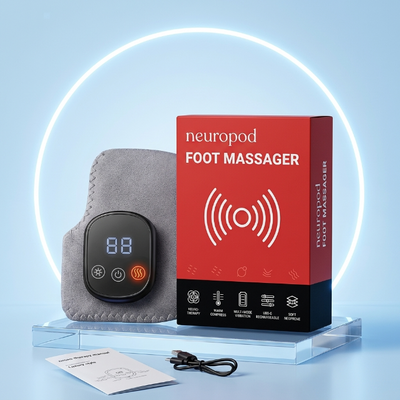
The Neuropod is a wearable foot therapy device that delivers heat, compression, and elevation in a single 15–30 minute session you do lying in bed.
- Infrared heat — five levels, 40°C to 60°C, penetrating directly into the fascia (not just warming the skin)
- Vibration compression — three modes, five speeds, targeting the heel, arch, and ankle at the same time
- Fully cordless and wearable — so you can lie back with your feet up on a pillow during the entire session. Elevation built in.
You wrap it on, press a button, lie back, and let it run. That's the whole protocol. Heat, compression, elevation. Daily. From your bed.
How it actually fits into your night
You don't need to add a single thing to your routine. You're already on the couch at 8pm with your shoes off. That's the whole window.
Wrap & lie back
Slip on the Neuropod, prop your feet on a pillow, press one button.
Heat + compression
Infrared warmth and rhythmic vibration work the heel, arch, and ankle together.
Auto shut-off
Timer ends the session for you. Most people fall asleep before it does.
What recovery actually looks like
Plantar fasciitis didn't develop overnight, and it won't disappear overnight. But the timeline is more predictable than most people expect once you're finally giving the tissue what it needs to heal.
Typical recovery timeline with daily use
Consistency is everything. Daily use, even on the good days. The fascia is finally getting the circulation it's been starved of for years — but only if you keep showing up.
How Neuropod compares to what you've already tried
| Custom Orthotics | Cortisone Shot | Physical Therapy | Neuropod | |
|---|---|---|---|---|
| Treats root cause | ✕ Cushions only | ✕ Suppresses inflammation | ✓ Partially | ✓ Heat + circulation |
| Cost | $300–$800 | $200+ per visit | $150 per session | Once · BOGO |
| Works while resting | ✕ | ✕ | ✕ | ✓ |
| Time required | All day in shoes | Doctor visit | 60-min sessions | 15–20 min/day |
| Lasting results | Wears down | Returns in 6–8 weeks | If you keep going | Designed for it |
